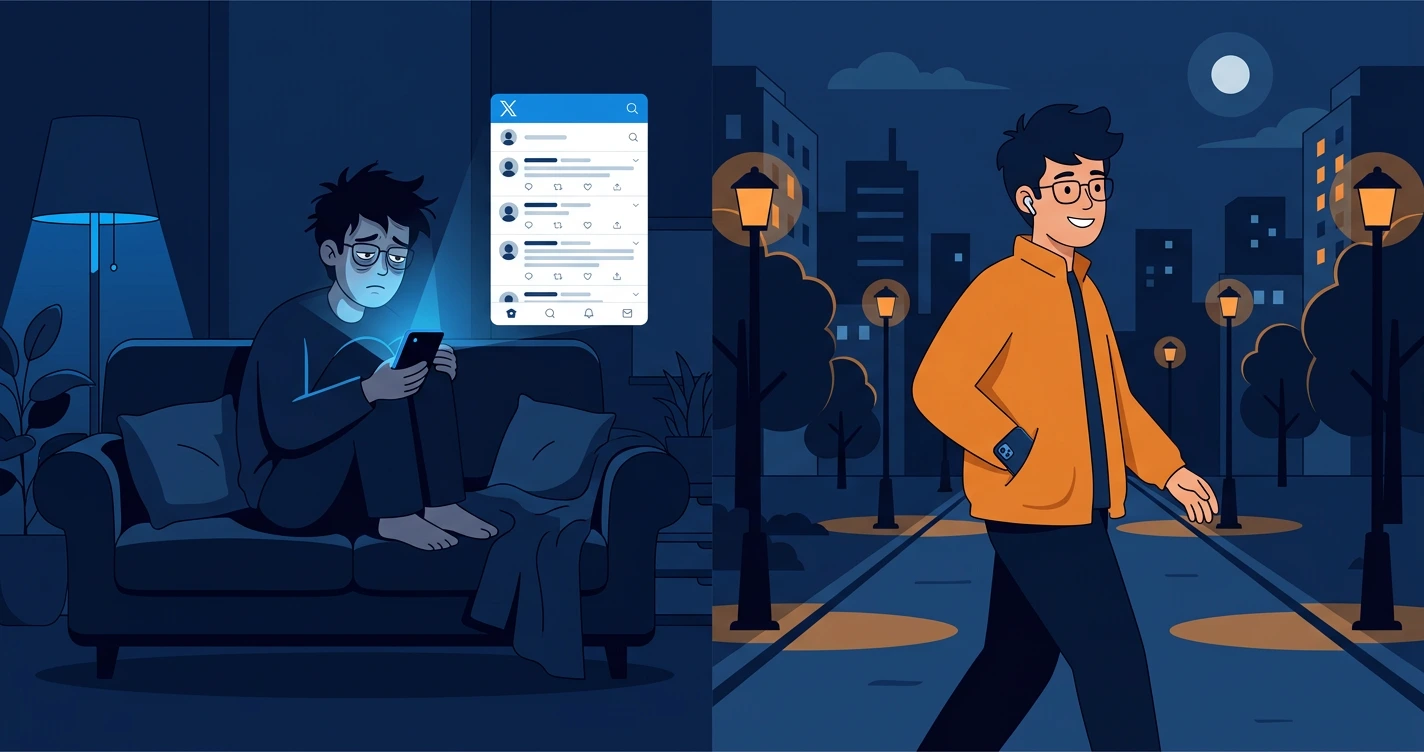
It's 2 PM. You opened Twitter to check one notification. Three hours later, you've scrolled through hundreds of posts and you can't remember a single one. You feel drained. You feel worse about the world. Welcome to doom-scrolling - and yes, it's a real phenomenon backed by research.
Why We Doom-Scroll
Doom-scrolling happens because of how social media is designed. Twitter's infinite scroll, constant notifications, and algorithmic feed create a psychological loop. You scroll for information, but the feed is also engineered to keep you scrolling. There's always one more tweet, always something new, always a reason to see what's next.
It's not a character flaw. It's the design working exactly as intended. Twitter makes money when you spend time on Twitter. The longer you're scrolling, the more ads you see. The system is optimized for engagement, not for your wellbeing.
The problem is compounded by what you're scrolling through. News cycles are accelerating. Outrage drives engagement. The algorithm learns that polarizing content keeps you clicking. So your feed becomes increasingly negative, increasingly stressful, and increasingly hard to stop consuming.
The Physical and Mental Toll
Doom-scrolling comes with real costs. Your posture degrades. Your eyes strain. Your sleep gets disrupted because the blue light and constant stimulation tell your brain it's daytime. More importantly, constant exposure to negative news and outrage triggers anxiety and depression. Studies show that heavy social media use correlates with worse mental health outcomes.
And here's the thing - you know it's unhealthy, but the mechanism is so effective that knowing doesn't help much. Willpower alone doesn't cut it when you're up against algorithms designed by teams of engineers.
Why Twitter Is Actually Perfect for Audio
Here's what most people miss: Twitter is uniquely suited for audio consumption. Unlike other platforms, tweets are text-first, self-contained, and short. A tweet doesn't require visual context. You don't need to see the color of someone's design or the facial expression in a video. The information is in the words.
This is why podcasts don't work as text, but tweets work great as audio. A podcast episode is 45 minutes - you need to commit to the whole thing. A tweet is a thought, usually 280 characters or less. It's the perfect unit for passive listening.
If you convert your Twitter feed to audio, something shifts psychologically. You're no longer scrolling - you're listening. You can do it while commuting, while cooking, while exercising. Your hands are free. Your eyes are free. You're not hunched over a screen.
And here's what happens: the passive consumption model breaks the doom-scroll cycle. You can't compulsively tap next when you're listening to a tweet - the audio will finish on its own. You get through your feed at a measured pace, not a frantic scroll.
The Solution: Make It Audio
This is why I built Xeder. It's a Chrome extension that reads your Twitter feed aloud using text-to-speech. Install it, click play, and your feed becomes something you listen to instead of scroll through.
The difference is subtle but powerful. You're still consuming the same content, but the medium changes the behavior. Audio naturally enforces breaks. Your brain processes spoken words differently than visual text. You feel less compelled to obsessively keep scrolling.
It's not a silver bullet - if you're determined to doom-scroll, you still can. But it removes friction from the healthy option and adds friction to the unhealthy one. That small difference is often all you need.
The best way to break a bad habit isn't willpower - it's changing the medium. Doom-scrolling thrives on visual compulsion. Audio removes that. (: